
Portable multimodal tracker for cargo and baggage
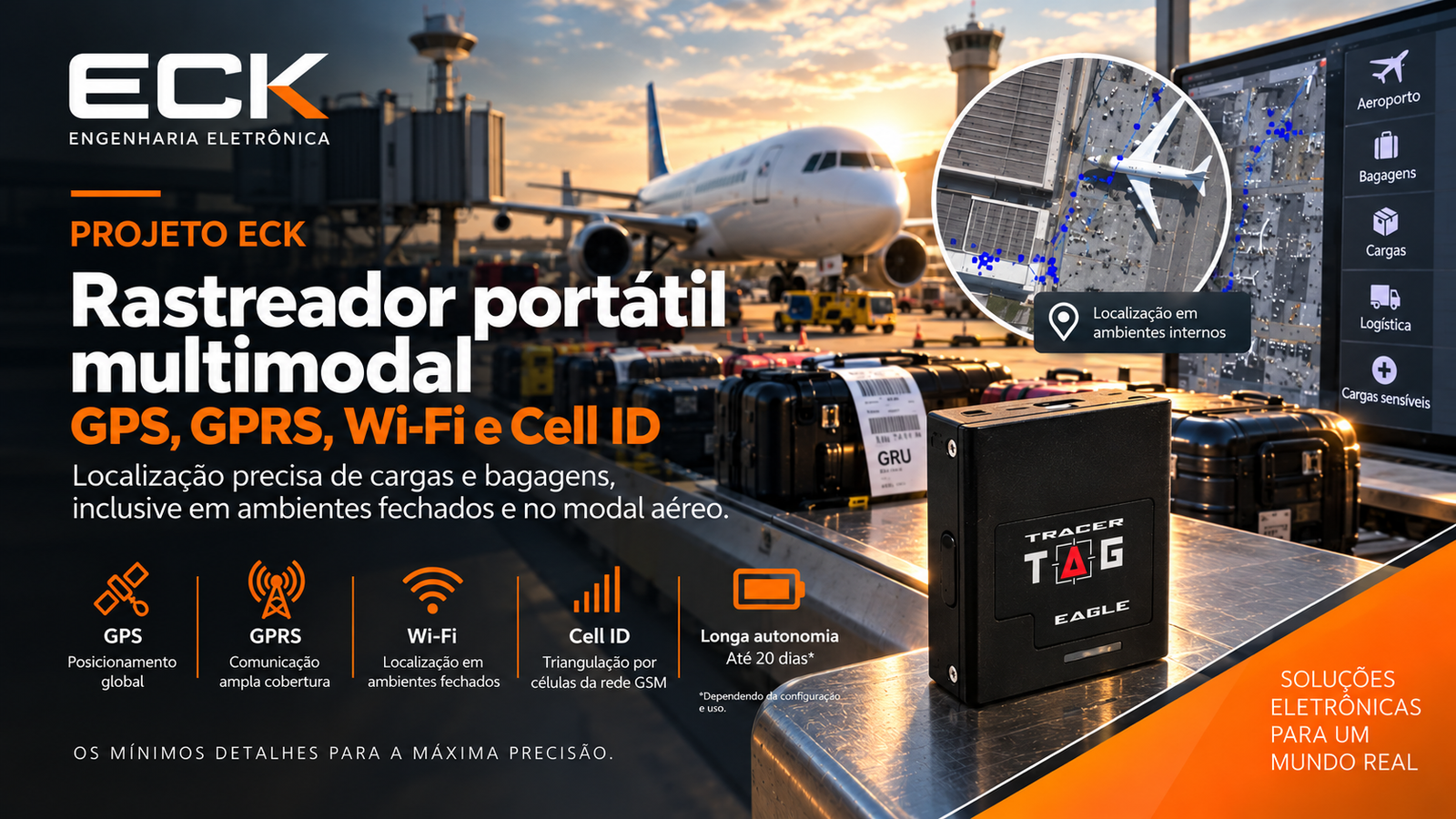
GPS, GPRS, Wi-Fi and Cell ID in a device designed to operate even in air transport.
The project
In 2004, ECK began developing a portable tracker originally designed to locate baggage, cargo and other assets in transit.
The project came from the idea of an aeronautical engineer who graduated from ITA, Brazil’s aeronautics institute, and was looking for a tracking solution able to follow cargo not only on land but also during air transport operations.
That created an unusual requirement for the time: the device had to be small, consume little power, use different location technologies and, at the same time, meet the restrictions that apply to electronic devices carried on aircraft.
The result was a platform that evolved over the years and came to be used in a range of tracking and monitoring applications.
A tracker roughly the size of a credit card
One of the main requirements was size.
The device had to be roughly the size of a credit card and about 12 mm thick.
Within that small volume we had to fit the processor, cellular modem, GPS receiver, Wi-Fi, accelerometer, power management, battery and several antenna systems.
Integrating so many radio frequency systems in such a small area became one of the main engineering challenges of the project.
The antennas had to work simultaneously without any one of them significantly degrading the performance of the others.
In addition, since the tracker would sit inside a suitcase or cargo, its physical orientation during use could not be predicted.
GPS, Wi-Fi and Cell ID working together
The system was designed to use different location technologies depending on the conditions available.
Outdoors, GPS provided the main positioning reference.
Where satellite reception was poor, the device could use cellular network information through Cell ID, as well as nearby Wi-Fi access points.
This combination significantly broadened the ways the device could be located.
An airport is a good example of the problem: there are outdoor areas with excellent GPS reception, but also terminals, warehouses and fully covered cargo areas.
Using these technologies together allowed the tracker to keep providing location information even in those situations.
The antenna challenge
The RF design required special attention.
Since the tracker could be in any position inside a piece of baggage or cargo, we looked for a solution that offered good reception in different orientations.
For GPS, a helical antenna was used, giving better behavior for this type of application.
Antenna performance was critical enough that even the properties of the enclosure material had to be controlled.
A change in the properties of the material near the antenna could detune it, shifting its operating frequency and reducing system performance.
Some of the antenna solutions used in the product were developed specifically for this application together with international suppliers.
Operation in air transport
Another key requirement was allowing the tracker to be used in air transport.
The device used a high-sensitivity accelerometer to analyze its state of motion.
The firmware continuously evaluated this information and identified sustained motion patterns consistent with air transport.
Under those conditions, the system could block radio frequency transmissions.
When conditions allowed operation again, the device resumed its communication and location functions.
This logic was part of an architecture designed specifically with air transport use in mind.
The tracker was tested for this application and approved for operation in that environment.
Low power consumption
Battery life was also an important requirement.
Later versions of the product used the STM32L151 microcontroller, from STMicroelectronics’ low-power family.
Beyond the processor’s low consumption, the hardware included power management able to control each subsystem individually.
GPS, cellular modem and other circuits could stay off when they were not needed.
The batteries were also selected not only for energy density, but for the need to operate across the wide temperature range found in different transport conditions.
Firmware and remote updates
From the start, firmware played a key role in the project.
Many of the product’s features depended on dynamically managing location, communication, power consumption and sensors.
A remote firmware update system was also developed.
This allowed devices already in the field to receive new versions and improvements without having to be physically returned for updating.
This turned out to be especially important because the product kept evolving for many years.
A platform that came to serve other applications
Although the project was initially designed for tracking baggage and cargo, its architecture proved flexible enough to serve other applications.
Versions were developed for different types of monitoring and transport.
Applications included sensitive cargo that required monitoring of temperature and environmental conditions, including transport of medical materials, blood and organs.
The combination of sensors, cellular communication, location and remote updates turned the device into a platform for a range of tracking solutions.
Development and evolution
The first prototype took roughly six months to develop.
This was followed by about a year of refinement, testing and product evolution.
Several versions were developed from the initial platform, incorporating new technologies and adaptations for different applications.
The project also went through certification and specific testing, including ANATEL certification (Brazil’s telecom regulator) and assessments related to use in air transport.
A project created in 2004 and still in use in 2026
Perhaps the most interesting outcome of this project is its longevity.
Development of the architecture began in 2004.
Over the years, components, firmware, communication and applications were updated, but the platform continued to serve as the basis for different client products.
In 2026, 22 years after development started, versions derived from this project are still in use.
For ECK, this project is a good example of how hardware and firmware architecture decisions can influence not only how a product works, but also its ability to evolve over many years.
Have an electronic product to develop?
Tell us the problem. The conversation starts with engineering, not with an off-the-shelf package.