
UL certification consulting for aesthetic equipment
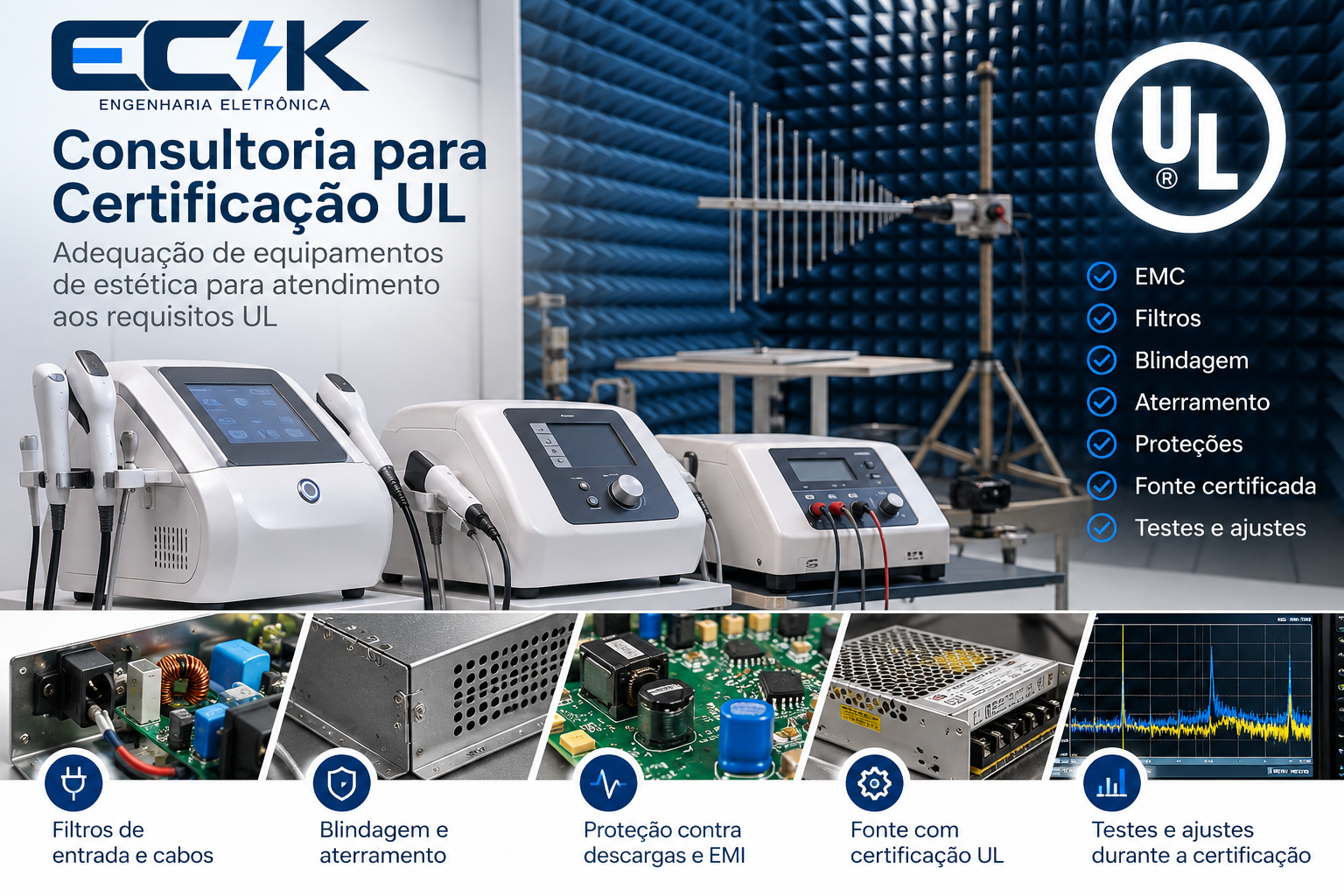
The client came to ECK with three aesthetic devices already in the UL certification process. Development was finished, testing had started and several technical problems were preventing the process from moving forward.
So the challenge was not designing the equipment from scratch. It was quickly identifying the causes of the failures, proposing viable fixes and validating each change within the lab time available.
The three devices used different technologies: an ultrasonic generator, a plasma generator and a Russian current stimulation device. Each had its own behavior and required specific analysis.
When problems appear during certification
In a project designed for certification from the start, many requirements can be handled at the specification, schematic and board layout stages.
In this case, however, the product was already finished and the problems emerged during testing.
ECK analyzed the applicable requirements and prioritized the points most likely to cause failures or rework. The work was then run in short cycles: test, identify the root cause, modify the device and repeat the test.
This process made it possible to move quickly even with many fixes required.
Electromagnetic interference in the ultrasonic generator
One of the biggest challenges came up in the ultrasonic generator.
The device used several magnetic components and power circuits that produced high levels of electromagnetic emissions during operation. In testing, these emissions exceeded the acceptable limits.
Work was needed on several parts of the device.
ECK developed and tuned filters, evaluated current paths and coupling, modified grounding and implemented shielding solutions to reduce radiated emissions.
Some of the shielding changes were made right during testing, using metal sheets and temporary solutions to quickly confirm whether a given approach produced the expected result before building it into the final product.
Line filters and cables
Changes were also needed at the power input and on the device cables.
Line filters, suppression components and additional filtering solutions were evaluated to reduce interference conducted through the power supply and external cables.
In some cases, commercial filters were used as a reference or as a solution to validate system behavior before defining the final set to be built into the product.
This kind of testing is particularly useful because it quickly separates problems originating in the internal circuit from those propagating through cables, the power supply or the mechanical structure.
Shielding and grounding
Adding filters alone does not always solve an electromagnetic compatibility problem.
The physical layout of components, return current paths, connections between boards, chassis and ground, and openings in the enclosure all directly affect the result.
During the consulting work, shielding and grounding changes were tested to reduce interference coupling to the outside and also increase the device’s immunity.
The goal was not to apply a generic fix, but to identify which coupling paths were actually causing the problems seen in testing.
Protections that also needed revisiting
Another important lesson came from the protection circuits.
An overly sensitive protection can be as problematic as an insufficient one. In one of the tests, the circuit’s behavior even tripped the lab’s test system.
The trip levels and protection behavior had to be revised so they would still do their job without causing nuisance shutdowns during normal operation or testing.
Improvements were also made to prevent unexpected processor states, including external supervision to increase system safety in the event of a software fault or lock-up.
Power supply and certified components
The analysis also identified components that were making certification harder.
Changes included replacing the power supply with a UL-certified model, reducing the number of points that would need to be demonstrated again within the final equipment.
Indicators and other product elements were also adapted to meet the requirements applicable to the assembly.
A week of testing and many modifications
The work was carried out while directly following the lab tests.
The client had booked extra lab time so the team could test alternatives and make modifications between one measurement and the next.
The whole process was intense and concentrated into about one week. Each failure found triggered a new sequence of diagnosis, modification and retest.
At the end, an extensive list of modifications was produced to be incorporated into the product and the production process: electronic changes, shielding, filters, components, assembly and other details needed to turn the tested solutions into permanent changes.
Outcome of the UL certification consulting
After the changes and validations made during the process, the devices were able to move forward and obtain UL certification.
The outcome showed the importance of treating certification as part of product development rather than an isolated step carried out only after the design is finished.
When safety, EMC, power supply, insulation, protection and mechanical construction requirements are considered from the start, the number of changes during testing tends to be much smaller.
Certification should start at the product specification
The main recommendation from this work is simple: if a product must meet a given standard, that standard needs to be analyzed before development starts.
This makes it possible to define early on the requirements for components, clearances, power supply, protection, grounding, shielding, connectors, indicators and test points.
It is also important to provide measurement points and features that make diagnosis easier during development. When a problem shows up in the lab, being able to quickly measure the device’s internal behavior greatly reduces the time needed to find the cause.
UL certification consulting can help both before testing, by reducing the risk of failure, and during a compliance effort when the product is already developed and needs specific fixes.
Learn more about ECK’s electronic engineering consulting and certification support.
Does your company have equipment that needs to be prepared or adapted for certification?
ECK can support the technical analysis, testing and the fixes required.