
Lummina 8: incubator with optical analysis by eight cameras
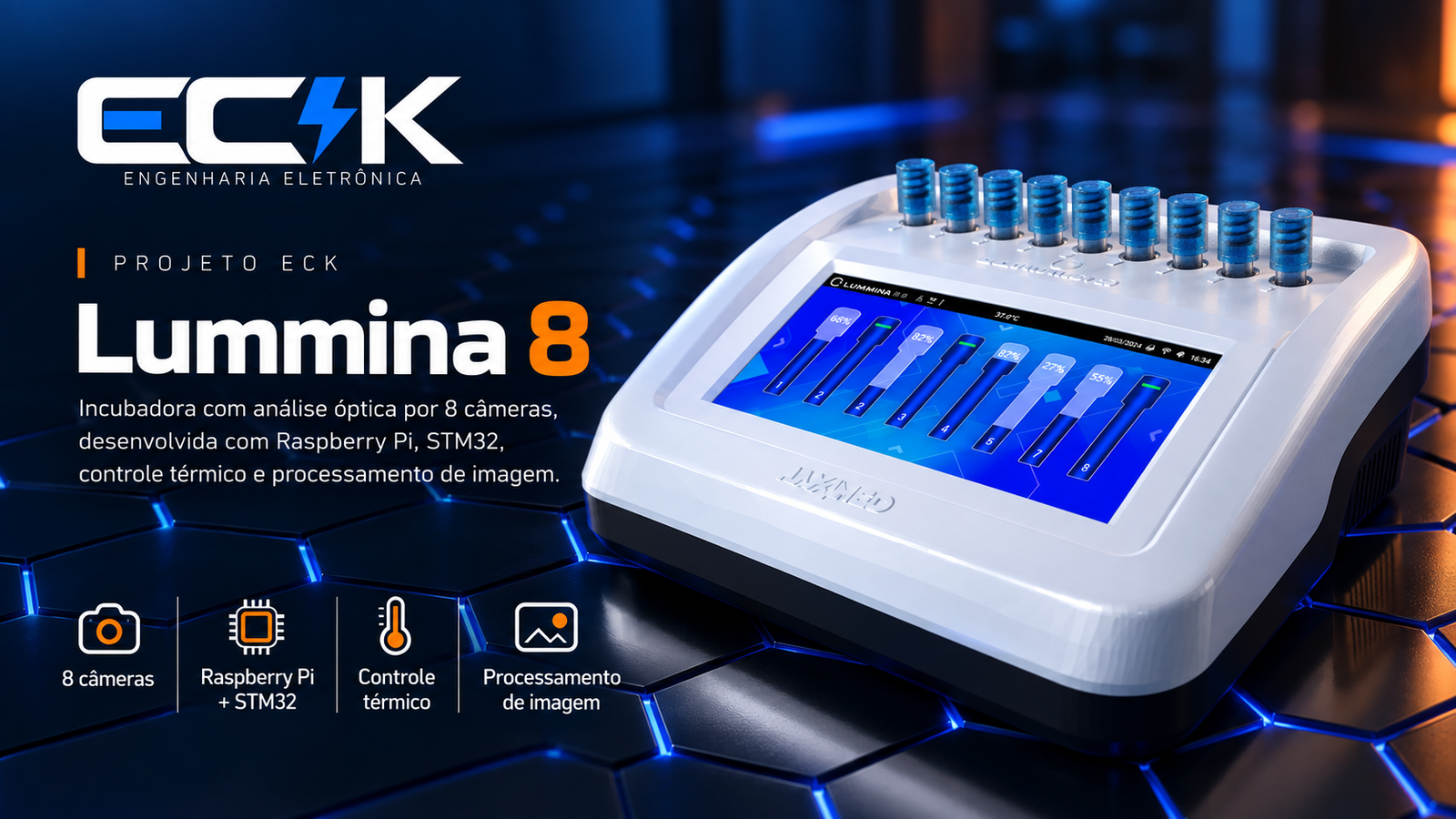
The Lummina 8 grew out of an idea from Maxximed to automate the reading of biological indicators used to verify sterilization processes.
The product had to incubate eight samples simultaneously and automatically track how they evolved using a camera-based optical system.
Development was carried out in partnership between ECK and WLD, combining embedded electronics, thermal control, image processing and development of the device interface.
Lummina 8 started with concept validation
Before coming to ECK, Maxximed had already tried to develop the solution with other suppliers, but the concept had not yet been demonstrated satisfactorily.
So, instead of going straight to full product development, an initial validation stage was proposed.
ECK developed a working MVP with the specific goal of checking whether the samples’ optical response could be detected reliably using cameras.
The agreement was structured to reduce technology risk for the client: first the working principle would be proven, and only then would the project move on to the complete product.
The first tests confirmed the architecture was viable. From that validation, development of the final Lummina 8 began.
Eight positions monitored by cameras
The Lummina 8 was designed with eight independent incubation positions.
Each position holds a sample used to verify the effectiveness of a sterilization process.
After the process, the sample is incubated under controlled conditions. When microorganisms survive, an optical response associated with biological activity occurs, which the system can track.
In the Lummina 8, this evolution is monitored by cameras. The device captures images of the samples and uses digital processing to determine their status.
Raspberry Pi for image processing and interface
The high-level core of the device is based on a Raspberry Pi.
This platform was used for the functions that required more processing power and a more sophisticated graphical interface:
- image acquisition from the cameras;
- image processing;
- analysis of the samples’ optical response;
- front display management;
- user interface;
- data logging;
- printing of results.
Using a Linux platform also brought flexibility to evolve the software and add new features.
STM32 for real-time control
While the Raspberry Pi handled processing and interface functions, an STM32 microcontroller took care of direct device control tasks.
Its responsibilities included incubator temperature control and camera selection.
This split made it possible to use each platform where it fit best: the Raspberry Pi for processing and interface, and the STM32 for deterministic hardware control tasks.
Thermal control and optical acquisition working together
An incubator for biological indicators requires thermal stability.
The reaction observed in the samples depends on controlled incubation conditions, so the system had to keep the temperature within the defined range while performing optical readings at the same time.
This required integrating thermal control, channel selection, image acquisition, processing and a graphical interface into a single architecture.
The result was a device significantly more complex than a conventional incubator.
From MVP to commercial product
After the initial validation, the project evolved into a complete commercial product.
Beyond the electronic circuit, it was necessary to integrate eight reading channels, cameras, Linux processing, an STM32 microcontroller, thermal control, a graphical display, user interface, printing, mechanics, firmware and software.
This kind of architecture requires hardware, firmware and software to be developed in a coordinated way, because changes in one subsystem can directly affect the behavior of the others.
A product that stayed stable on the market
The Lummina 8 reached the market and became part of Maxximed’s commercial line.
The device was shown at trade fairs and has remained on sale over the years.
Notably, after the adjustments made during development, no major architecture changes were needed during roughly four years of commercial use.
This is significant in a product that combines thermal control, image processing, multiple cameras and a sophisticated graphical interface.
The importance of validating before developing
Perhaps the main lesson of this project lies at the start of the process.
When there is significant technological uncertainty, immediately developing the complete product can be a high risk for both client and supplier.
In the case of the Lummina 8, it was first shown that the physical principle and the reading method worked. Only then were resources invested in the final product.
The initial MVP removed the biggest technical uncertainty before the complete mechanics, electronics and software were developed.
Multidisciplinary engineering applied to the product
The Lummina 8 is an example of a product with no single dominant technology.
The result depends on combining embedded electronics, thermal control, computer vision, Linux, firmware, a graphical interface and mechanical integration.
ECK’s contribution lay precisely in integrating the different technologies needed to turn an idea that was initially hard to validate into a commercial product.
See other electronic engineering projects developed by ECK.
Need to validate and develop a complex electronic product?
ECK can start with a proof of concept or MVP and evolve the solution into the final product.