
Battery-free solar pump with a capacitor bank
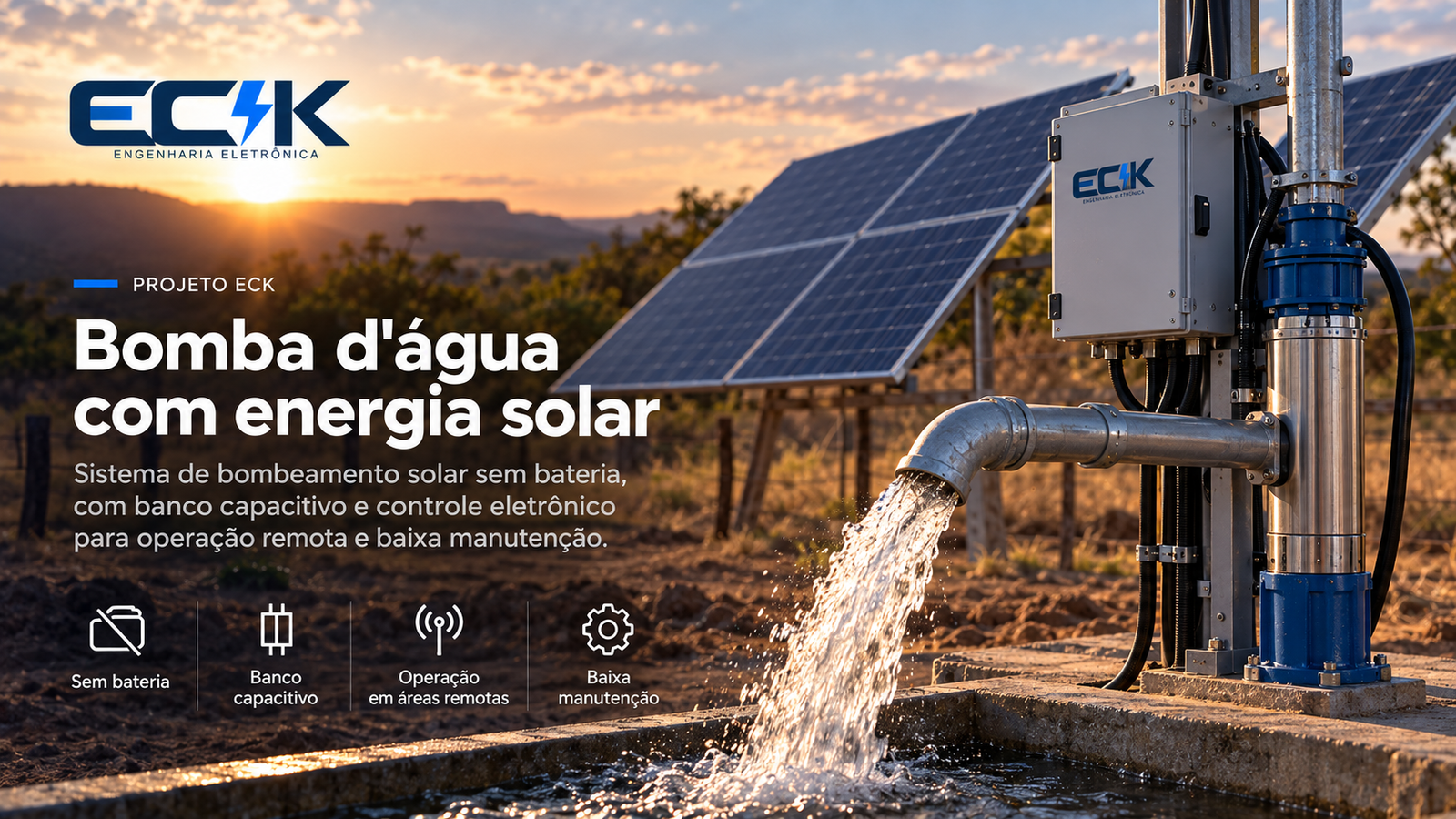
This project grew out of a very specific need: developing a water pumping system powered directly by solar energy, able to operate in remote locations with as little maintenance as possible.
An earlier development had been started abroad, but it was stopped before reaching a usable solution. ECK was then hired to take over the problem and develop an electronic architecture able to use the energy from the solar panels directly, without batteries.
The core of the project was simple to describe but technically challenging: the available energy varied continuously with solar irradiance, while the pump needed energy pulses strong enough to move the mechanical assembly.
Storing energy without a battery
The solution adopted was based on a capacitor bank.
Energy from the solar panels, at a voltage in the tens of volts, was accumulated in this capacitor bank. Instead of trying to power the pump continuously from a source whose output varied throughout the day, the system waited until enough energy had been stored.
A microprocessor continuously monitored the capacitor bank voltage.
When the voltage reached the level set for operation, the controller released an energy pulse to the pump actuator. After the pulse, the system went back to accumulating energy until the condition for the next cycle was reached again.
This strategy effectively decoupled the variable energy generation of the solar panel from the pump’s instantaneous demand.
High-voltage bus and H-bridge drive
The pump was a diaphragm type and needed an alternating drive to complete its mechanical stroke.
The electronic circuit boosted the stored energy onto a high-voltage bus, in the order of hundreds of volts, and used an H-bridge to apply the energy alternately in opposite directions.
The pump was connected between the legs of the bridge.
In one cycle, current flowed in one direction; in the next, in the opposite direction. This way, the assembly completed the full diaphragm movement that pumped the water.
The timing of these pulses was controlled by the microprocessor according to the energy available in the capacitor bank.
Pump frequency follows the available energy
One of the most interesting features of the architecture was how the system naturally adapted to the amount of solar energy available.
With strong sunlight, the capacitor bank quickly reached the required voltage. Pulses were more frequent and the pump could move more water.
When irradiance dropped, the capacitors took longer to charge. The system did not try to artificially keep the same frequency; it simply increased the interval between pulses.
Under very low irradiance, the pumping rate could drop considerably, but the architecture kept using the available energy whenever the bank reached the level needed for a new cycle.
This made it possible to extract useful energy from the panel across a very wide range of environmental conditions, without needing an intermediate battery.
Eliminating the battery reduced maintenance
Doing without a battery was an important decision for the application.
The equipment was meant to be installed in remote locations, where periodic maintenance to replace batteries, check electrolyte or swap accumulators would be costly and, in some cases, difficult.
With the capacitor bank, energy storage was used only to accumulate the amount needed for each pumping pulse.
This made it possible to build a low-maintenance system suited to staying in the field for long periods.
Use in wells and remote regions
The product was used in systems drawing water from wells, including installations with pipes of roughly four inches in diameter.
The idea was to enable pumping in regions without electrical infrastructure, using only the solar panel and the control electronics.
Solutions of this type were used in harsh environments and hard-to-reach regions, including desert and arid areas, where reliability and low maintenance were as important as system efficiency.
The concept proved particularly suitable for applications where the goal was not to maintain a constant instantaneous flow, but to continuously use the solar energy available throughout the day to move water.
Electronic control based on available energy
From an engineering standpoint, the project is an interesting example of how a load can be controlled according to the energy actually available, rather than requiring a stable source sized for peak power.
The control logic had to measure the capacitor bank, decide when there was enough energy for a cycle and drive the H-bridge safely.
Beyond normal control, the electronics had to account for the behavior of the high-voltage bus, capacitor discharge, start-up conditions and the robustness needed for extended field operation.
Electronic design driven by the real application
The final solution did not come simply from choosing a solar panel or a pump.
It came from integrating energy harvesting, capacitive storage, voltage conversion, power drive, embedded control and the mechanical behavior of the assembly.
This kind of development shows an important trait of electronic energy projects: often the problem is not simply generating or converting power, but adapting the load to the real profile of the available source.
ECK developed the electronic architecture with exactly this goal, creating a system able to operate without a battery, with low maintenance and suited to remote installations.
See other electronic engineering projects developed by ECK.
Need to develop a solar-powered electronic system?
ECK develops solutions for variable sources, remote operation and low maintenance.