
Electric vehicle chargers (EVSE): architecture, communication and certification
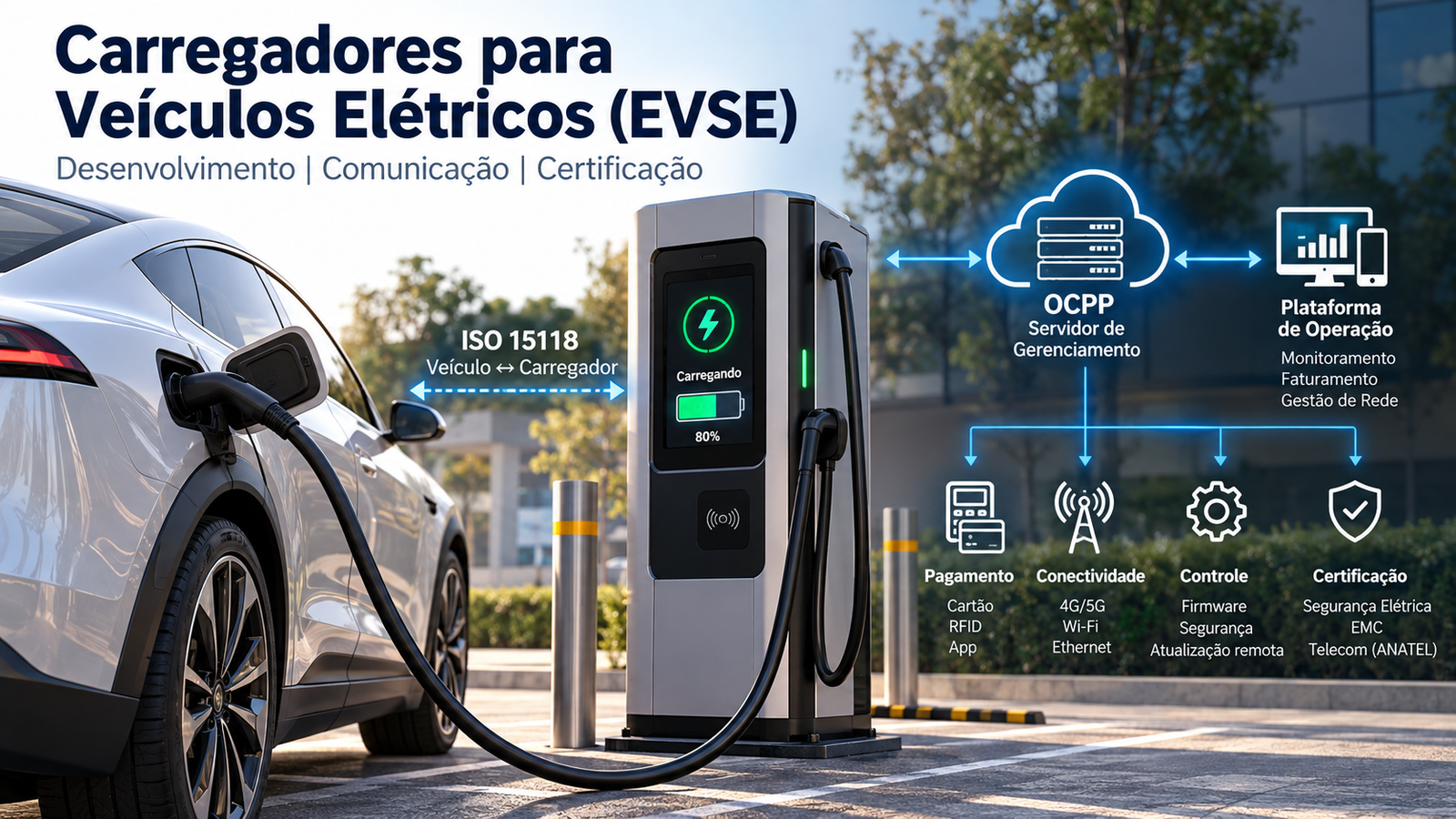
The growth of electric vehicles is creating a new category of fairly complex electronic equipment: electric vehicle chargers, known as EVSE (Electric Vehicle Supply Equipment).
Although from the outside a charger may look like a simple interface between the grid and the vehicle, inside there is a combination of power electronics, embedded systems, communication, connectivity, metering, electrical safety and software.
In connected chargers, the architecture may also involve management servers, apps, payment systems and integration with operating platforms. That is why EVSE development should be treated as a complete electronic system, not simply as a high-power power supply.
How is an electric vehicle charger architected?
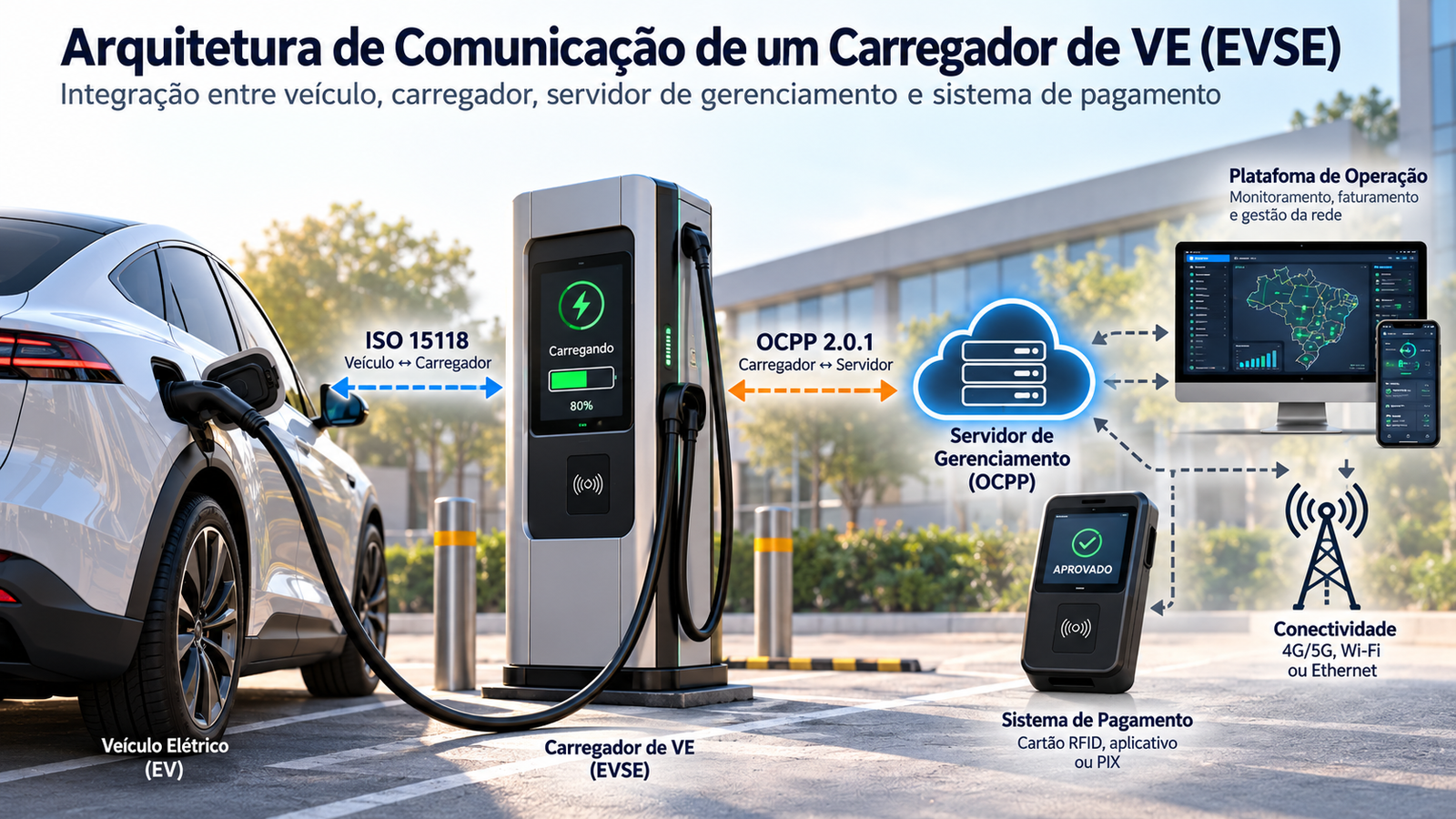
A connected charging system can be divided into three main parts: the electric vehicle, the EVSE charger and the management infrastructure.
The charger controls the energy transfer and continuously checks the conditions required for charging to proceed safely. More sophisticated systems also need to exchange information with both the vehicle and external servers. This is where two important protocols come in: ISO 15118 and OCPP.
Vehicle-to-charger communication: ISO 15118
ISO 15118 covers digital communication between the electric vehicle and the charging infrastructure. This communication lets vehicle and charger exchange information related to the charging session. Depending on the implementation and version, features may include identification and authentication, parameter negotiation and Plug & Charge functions.
This communication essentially takes place on the Vehicle ↔ EVSE link and should not be confused with communication between the charger and the management server.
Charger-to-server communication: OCPP
OCPP (Open Charge Point Protocol) works at another layer of the architecture. It enables communication between the charger and a central management system, often called a CSMS (Charging Station Management System).
Through this connection, functions such as charging session tracking, charger status, event logs, remote management, parameter updates and integration with operational and commercial systems can be implemented. Here we have EVSE ↔ OCPP ↔ management server.
Payment, connectivity and operating platform
At a public station, the process does not end with communication with the vehicle. The system may need to identify the user and tie the charging session to billing mechanisms. Depending on the business model, this may involve cards, RFID, apps, instant payments or integration with other payment systems.
The charger may also have different connectivity options, such as Ethernet, Wi-Fi or 4G/5G cellular networks. The operating platform can aggregate information from many chargers for monitoring, station management, user control, reporting and billing.
This separation matters because OCPP is neither the payment system nor the commercial platform. It is a protocol used for communication between the charging station and the central system.
What is inside a DC fast charger?
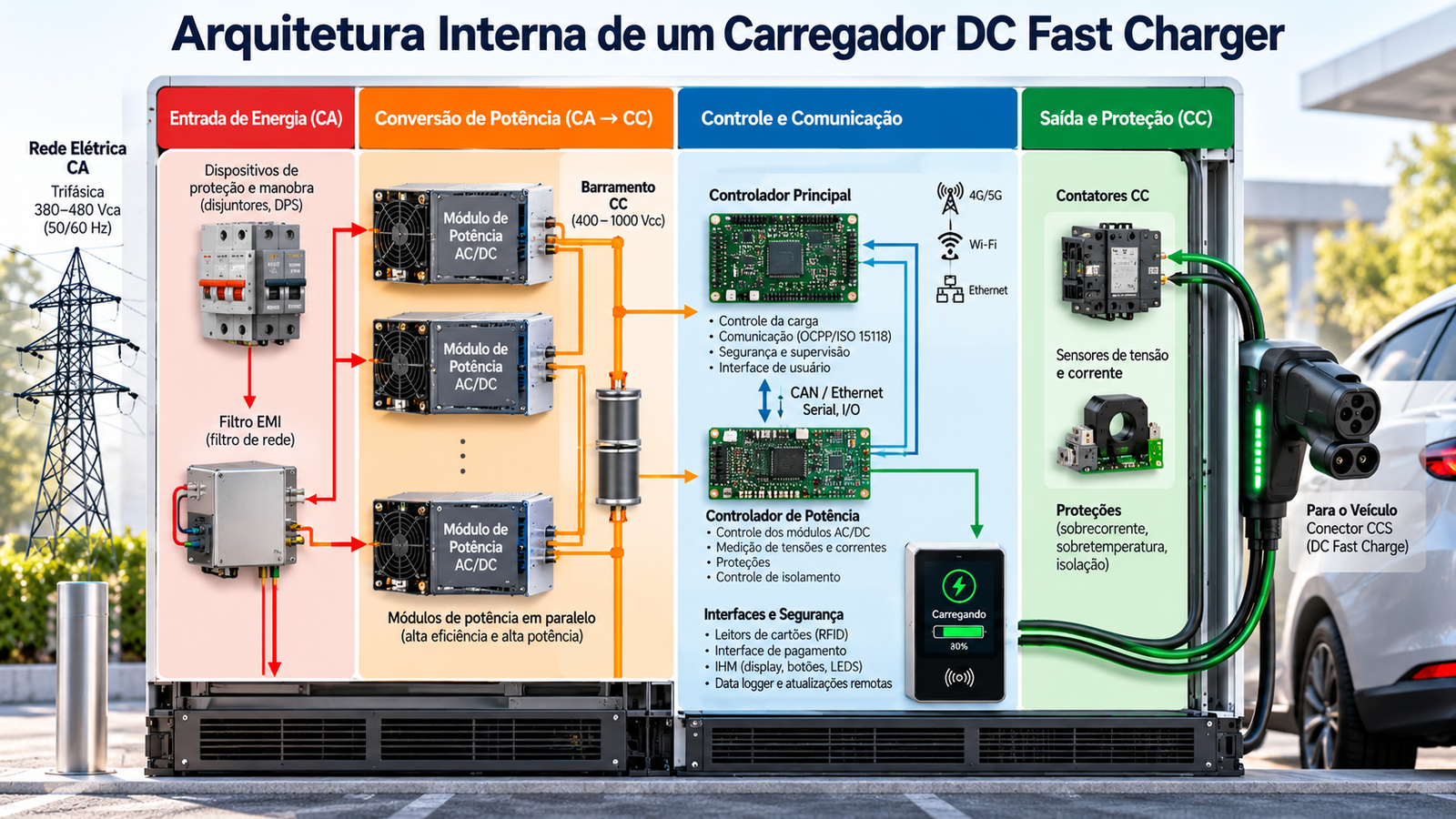
In DC fast electric vehicle chargers, energy from the grid has to be converted and controlled before being delivered to the vehicle. A typical architecture may include input protection, EMI filtering, power conversion stages, a DC bus, AC/DC modules, contactors, voltage and current sensors, control systems and communication circuits.
Higher-power chargers may use multiple power modules working in parallel, increasing the unit’s capacity and creating a modular architecture. The embedded system coordinates these blocks, supervising voltages, currents, temperatures, contactor states and various safety conditions.
The control system is a critical part of the EVSE
At the center of this architecture there are usually one or more embedded controllers. They may be responsible for controlling the power modules, acquiring sensor data, managing contactors, communicating with the vehicle, the user interface and communication with external systems.
Depending on the product architecture, this may involve microcontrollers, microprocessors, CAN interfaces, Ethernet, serial communication and cellular or Wi-Fi modules. Diagnostic and firmware update mechanisms must also be provided, especially when chargers are geographically distributed.
Electrical safety and electromagnetic compatibility
An electric vehicle charger handles significant power levels, so safety has to be part of the architecture from the earliest stages of the project. Aspects to consider include overcurrent and overvoltage protection, insulation, grounding, electrical monitoring, temperature, contactors and abnormal operating conditions.
Switching power converters can generate conducted and radiated noise. At the same time, the control electronics must keep working correctly when subjected to the electromagnetic disturbances expected in their operating environment. That is why EMI filters, board layout, grounding, shielding, component selection and mechanical architecture should not be left until the end of development.
Technical standards and charger certification
Key technical references used in charging system development include the IEC 61851 series, covering conductive charging systems, and ISO 15118, covering communication between the vehicle and the charging infrastructure. The international standards are available directly from IEC and ISO.
However, it is important to distinguish a technical standard from mandatory certification. The existence of a standard applicable to a product does not automatically mean that the equipment requires mandatory certification, for example by INMETRO in Brazil.
When the equipment includes telecommunications interfaces, such as Wi-Fi, Bluetooth or cellular, the regulatory requirements applicable to the radio frequency modules and interfaces used must also be analyzed. Before starting development, it is advisable to carry out a specific regulatory survey for the product configuration and the market where it will be sold.
Designing for certification reduces rework
A common mistake in electronic products is to develop the equipment first and look at regulatory requirements only once the prototype is ready. In power equipment, this approach can lead to significant changes in hardware, PCB, filters, insulation, enclosure and even the overall product architecture.
Ideally, electrical safety, EMC, telecommunications and communication requirements should be considered from the initial architecture definition. This turns regulatory requirements into engineering specifications and reduces the risk of discovering problems only during lab testing.
Electronics development for charging systems
Developing electric vehicle chargers involves several engineering disciplines that must work together. See other ECK electronic engineering projects.
ECK Engenharia Eletrônica works on hardware and embedded firmware development, IoT and communication systems, sensor and control interfaces, electromagnetic compatibility and technical support for certification processes. This experience can be applied to developing electronic modules, controllers and subsystems for charging equipment and electric vehicle infrastructure.
The goal is to consider from the outset not just how the prototype works, but also industrialization, reliability, communication and compliance with the product’s technical requirements.
Have an electronic product to develop?
Tell us the problem. The conversation starts with engineering, not with an off-the-shelf package.