
Micro-energy harvesting and management system for IoT devices
Harvesting micro-energy from the environment, managing it efficiently and storing it to extend the battery life of low-power sensors and IoT devices.
Micro-energy harvesting can extend the battery life of IoT devices installed in the field, where power supply is one of the main design challenges. When periodically replacing batteries is difficult, expensive or undesirable, one alternative is to use small amounts of energy available in the environment itself.
This technique, known as energy harvesting, can use sources such as light, vibration and temperature differences. The harvested energy is conditioned and managed to power the electronic circuit and recharge a storage element, significantly extending the device’s autonomy.
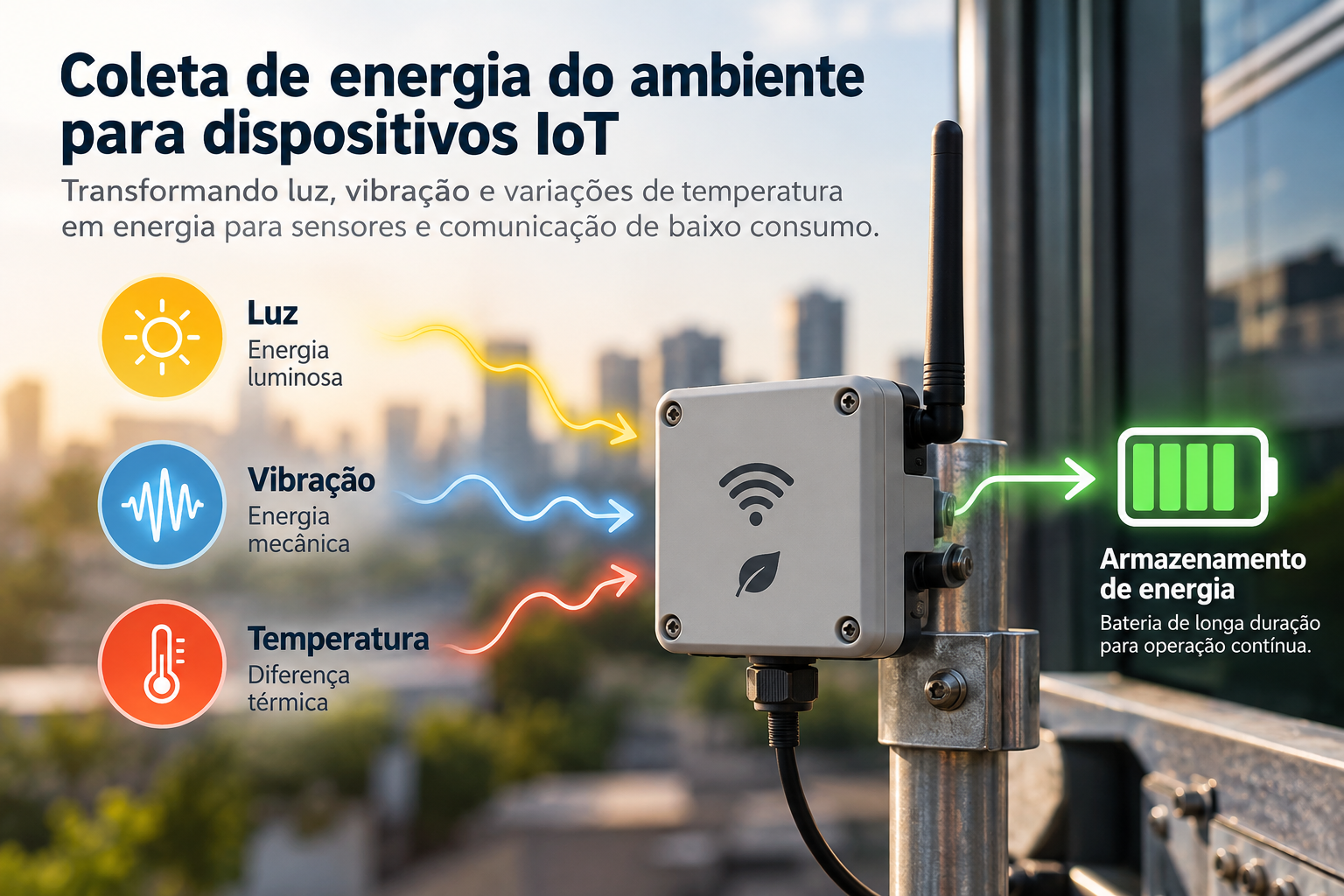
How does micro-energy harvesting work in IoT devices?
In micro-energy harvesting, the amount of energy available in the environment is usually small and variable. So it is not enough to connect a power source directly to the battery. A specialized circuit is needed to capture this energy, convert it efficiently and control how it is stored.
In a typical architecture, the micro-energy source feeds a power management circuit, or PMIC. This circuit conditions the available energy and controls charging of the storage element. The stored energy is then used by the IoT device’s sensor, microcontroller and communication system.
In a micro-energy harvesting project, the engineering challenge is balancing three factors: the energy that can be harvested from the environment, the storage capacity and the device’s consumption.
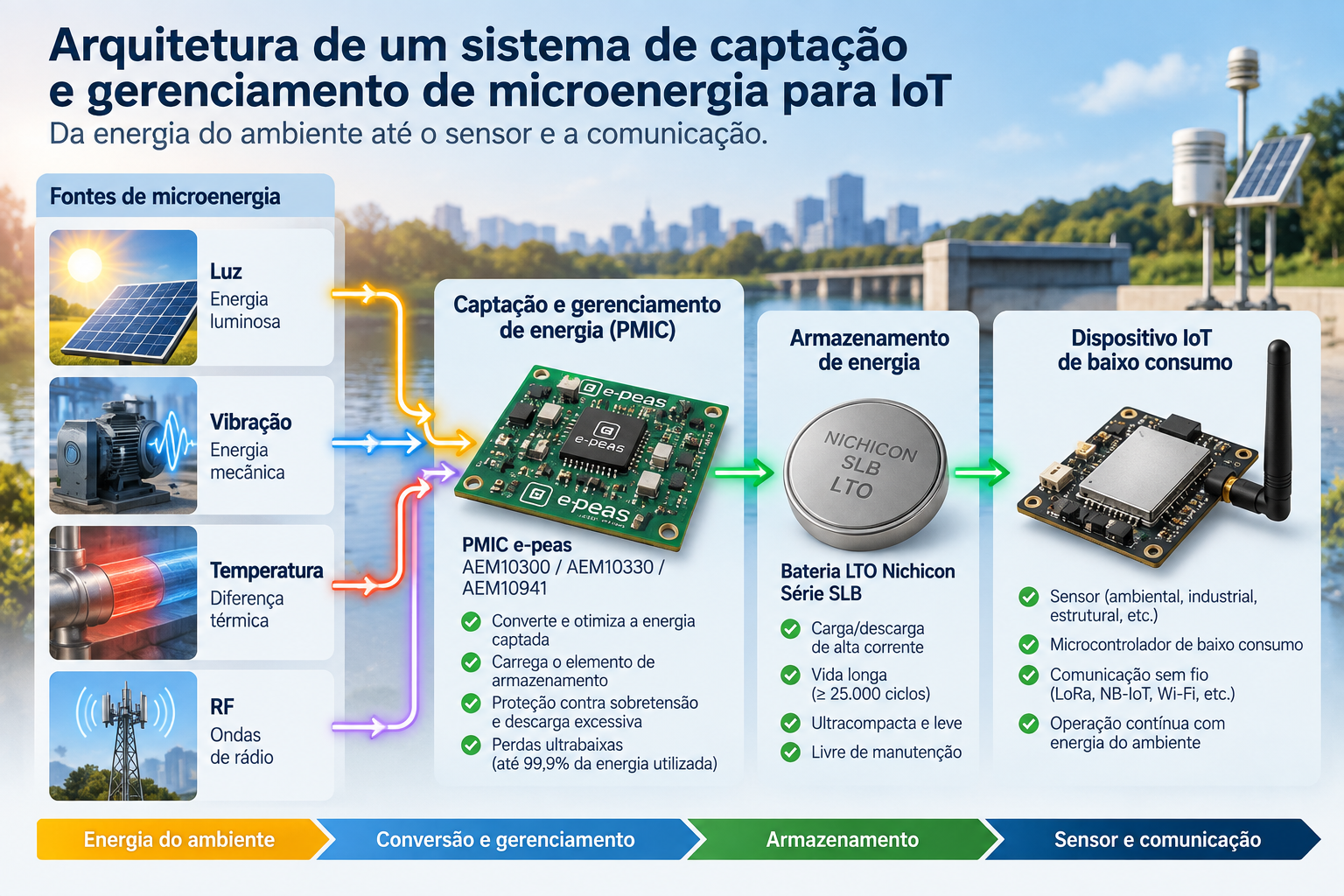
PMICs for energy harvesting and management
One example of this type of solution is the e-peas range of energy harvesting ICs. The company offers PMICs designed to work with small energy sources and storage devices.
The solutions mentioned include the AEM10941, AEM10330 and AEM10300 converters. These components can be combined with miniature rechargeable lithium titanate (LTO) batteries, such as the NICHICON SLB series.
According to the manufacturers’ data, the SLB series is intended for IoT applications and can reach at least 25,000 charge and discharge cycles. Combining the PMIC and the storage device aims to create a compact, long-lasting solution for sensors and other equipment that run on very little available energy.
Battery management and protection
Besides converting the harvested energy, the management circuit has to work according to the characteristics of the storage element.
The AEM10300 and AEM10330 have predefined settings for different storage elements. The AEM10941 allows custom configuration, so the parameters can be matched to the battery used in the application.
The PMICs also include protection against overvoltage and deep discharge. This management matters because the goal is not just to harvest energy, but to make proper use of the small amount available and keep the system operating within the battery’s specified conditions.
An example of extended autonomy
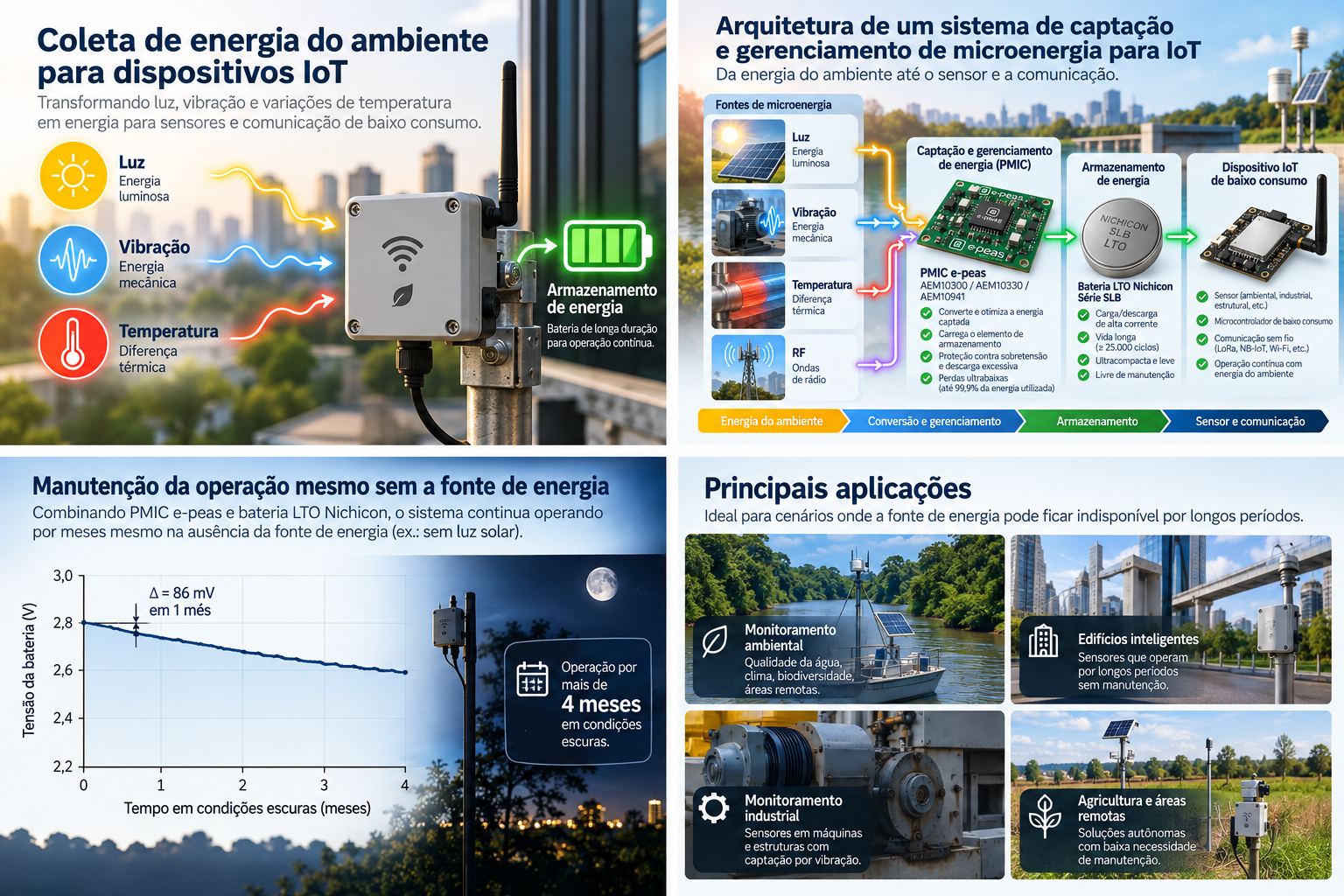
A test presented for the combination of the NICHICON SLB03070LR35 battery with the e-peas AEM10300 shows the potential of this kind of architecture.
In the test, the system kept powering the sensor for more than four months in the dark, a period in which the light source used for energy harvesting no longer contributed to the system.
During this period, the sensor kept sending data to a remote gateway. The recorded data shows a drop of roughly 86 mV in battery voltage over one month of operation under these conditions.
This result is more interesting than simply claiming a battery can last forever. In practice, autonomy depends on the project’s complete energy balance: how much energy can be harvested, how much the device consumes, how often it transmits data and the capacity of the storage element.
Where can this concept be applied?
Micro-energy harvesting and management solutions are especially interesting for sensors and IoT devices installed where frequent maintenance is inconvenient.
One example is environmental and smart building monitoring, where the device may spend long periods with little energy available but still needs to keep sensing and communicating.
The concept can also be considered for any application where some ambient energy source can be used and the device’s average consumption is low enough to keep a favorable energy balance.
Electronic design of low-power IoT systems
Using micro-energy does not depend only on choosing the PMIC or the battery. The complete design has to account for the consumption of the microcontroller, sensors, regulators, interfaces and, above all, the communication system.
Development should analyze active and sleep periods, measurement and transmission frequency and the energy actually available in the application. This way, energy harvesting becomes part of the product architecture, not just an add-on component.
For applications that require architecture analysis, hardware and firmware development or integration with sensors and communication systems, ECK develops electronic engineering projects focused on the complete solution. For technical references on micro-energy harvesting components, see the manufacturers e-peas and NICHICON.
Need to develop a low-power IoT device?
ECK works on hardware, firmware, sensors, communication and power management.