
How does NIBP blood pressure measurement work?
How does NIBP work? In automatic monitors, non-invasive blood pressure is derived from the small pressure oscillations that heartbeats produce in the cuff. Behind the systolic, diastolic, mean pressure and pulse rate numbers there is a system that combines pneumatics, a pressure sensor, electronics and signal processing.
How does NIBP work with the oscillometric method?
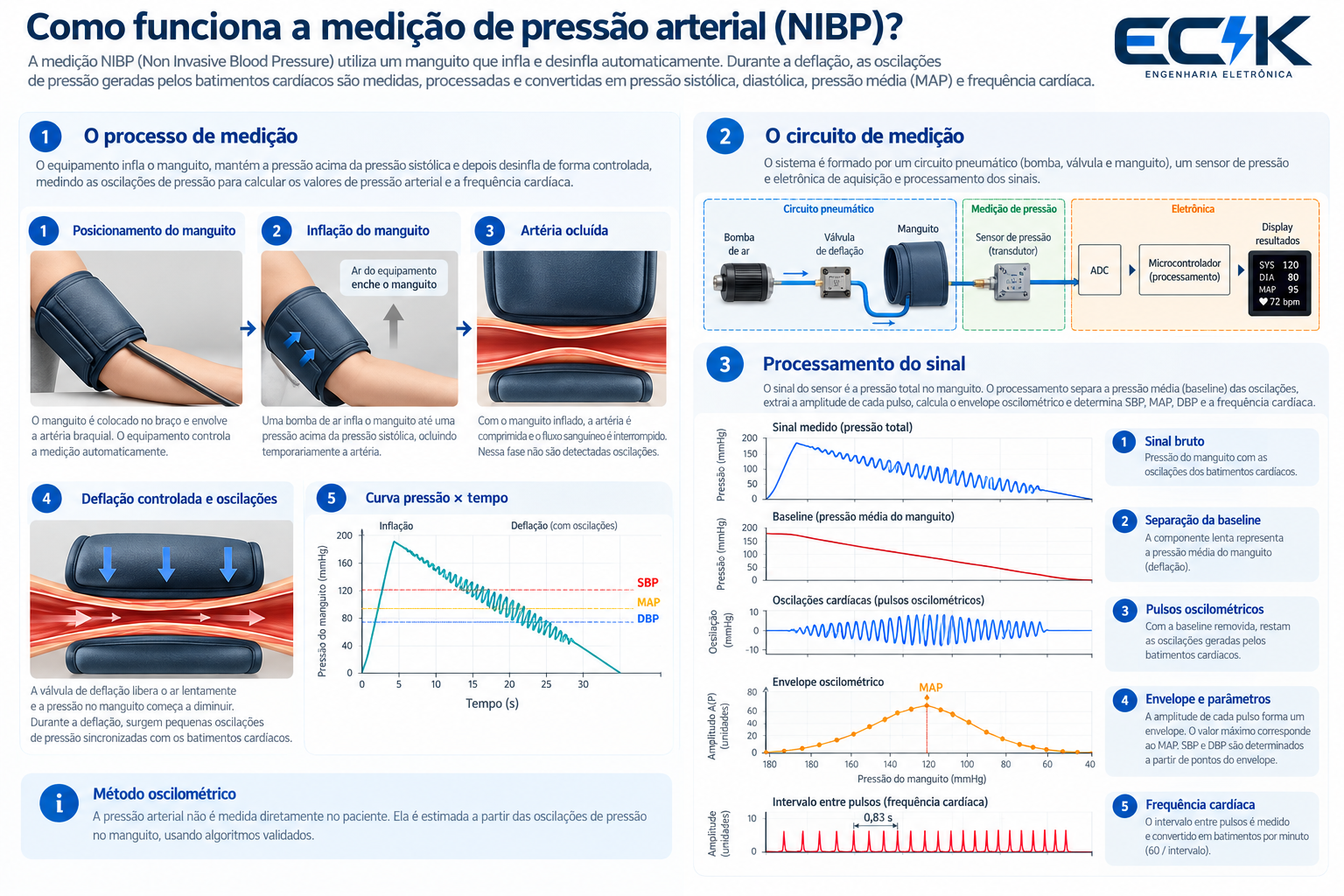
NIBP stands for Non-Invasive Blood Pressure. In the oscillometric method, a cuff is inflated above systolic pressure, temporarily compressing the artery. The device then starts a controlled deflation while continuously measuring the pressure inside the cuff.
The key point is that this pressure does not fall in a perfectly smooth way. Heartbeats produce small variations on top of the deflation curve. These are the oscillometric pulses, which give the algorithm the information it needs to estimate the blood pressure parameters.
How NIBP works: from cuff inflation to oscillations
When a measurement starts, a small air pump inflates the cuff. Once the programmed pressure is reached, the pump stops and a valve begins releasing air in a controlled way. Meanwhile, a transducer continuously measures the pneumatic pressure.
As pressure falls and blood flow gradually returns to the artery, each heartbeat causes a small oscillation in the signal. So the sensor does not directly measure 120 over 80: it measures the total cuff pressure, made up of the slow deflation curve plus the oscillations associated with the heartbeats.
The NIBP measurement circuit
The signal path starts in the pneumatic system: cuff, pump and deflation valve. The pressure sensor converts cuff pressure into an electrical signal, which is conditioned and converted to the digital domain. The microcontroller then receives a sequence of pressure samples over time.
In simplified form, the chain is: cuff → pump and valve → pressure sensor → conditioning and A/D conversion → microcontroller → signal processing → SYS, DIA, MAP and heart rate.
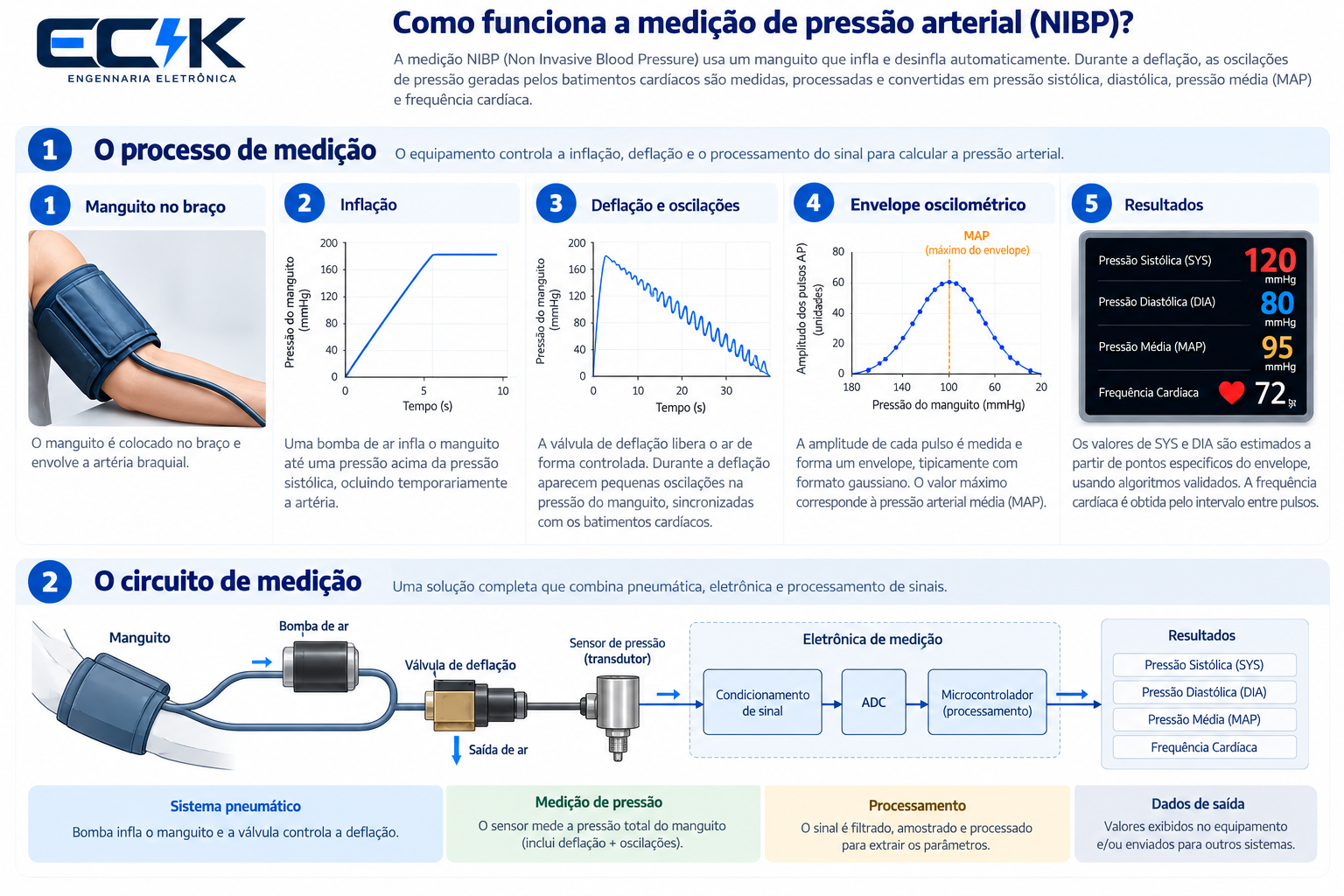
NIBP circuit: pneumatic system, pressure sensor, electronic acquisition and digital processing.
How is the signal processed?
The first processing challenge is separating two components that arrive mixed together. The baseline represents the slow pressure change caused by deflation. On top of it sit the oscillometric pulses. The algorithm estimates this reference curve and separates the pulsatile component.
It then measures the amplitude of each pulse as a function of the cuff pressure at that moment. These amplitudes start small, grow, reach a maximum and then decrease. Together they form what is called the oscillometric envelope.
The region of maximum amplitude is associated with mean arterial pressure, or MAP. Systolic (SYS) and diastolic (DIA) pressures are estimated from the characteristics of the envelope and from criteria defined and validated by the manufacturer. That is why different devices may use their own algorithms and coefficients.
And how does the device calculate pulse rate?
The same oscillometric pulses also make it possible to determine heart rate. The system measures the interval between successive pulses. An average interval of roughly 0.83 seconds, for example, corresponds to about 72 beats per minute.
So blood pressure and heart rate are extracted from the same pneumatic signal, but through different processing.
Why does NIBP measurement quality depend on the whole system?
The processing chain is interdependent: quality of the deflation curve → quality of the pulse amplitudes → quality of the envelope → quality of the MAP, SYS and DIA estimates. Arm movement, variations in deflation dynamics, noise and other artifacts can interfere with the signal and must be taken into account during development.
An NIBP device is therefore an interesting example of integration between pneumatic mechanics, sensors, analog electronics, A/D conversion, firmware and digital signal processing. See other electronic engineering projects developed by ECK.
Have an electronic product to develop?
Tell us the problem. The conversation starts with engineering, not with an off-the-shelf package.