
Multi-frequency ultrasonic driver with resonant frequency scanner
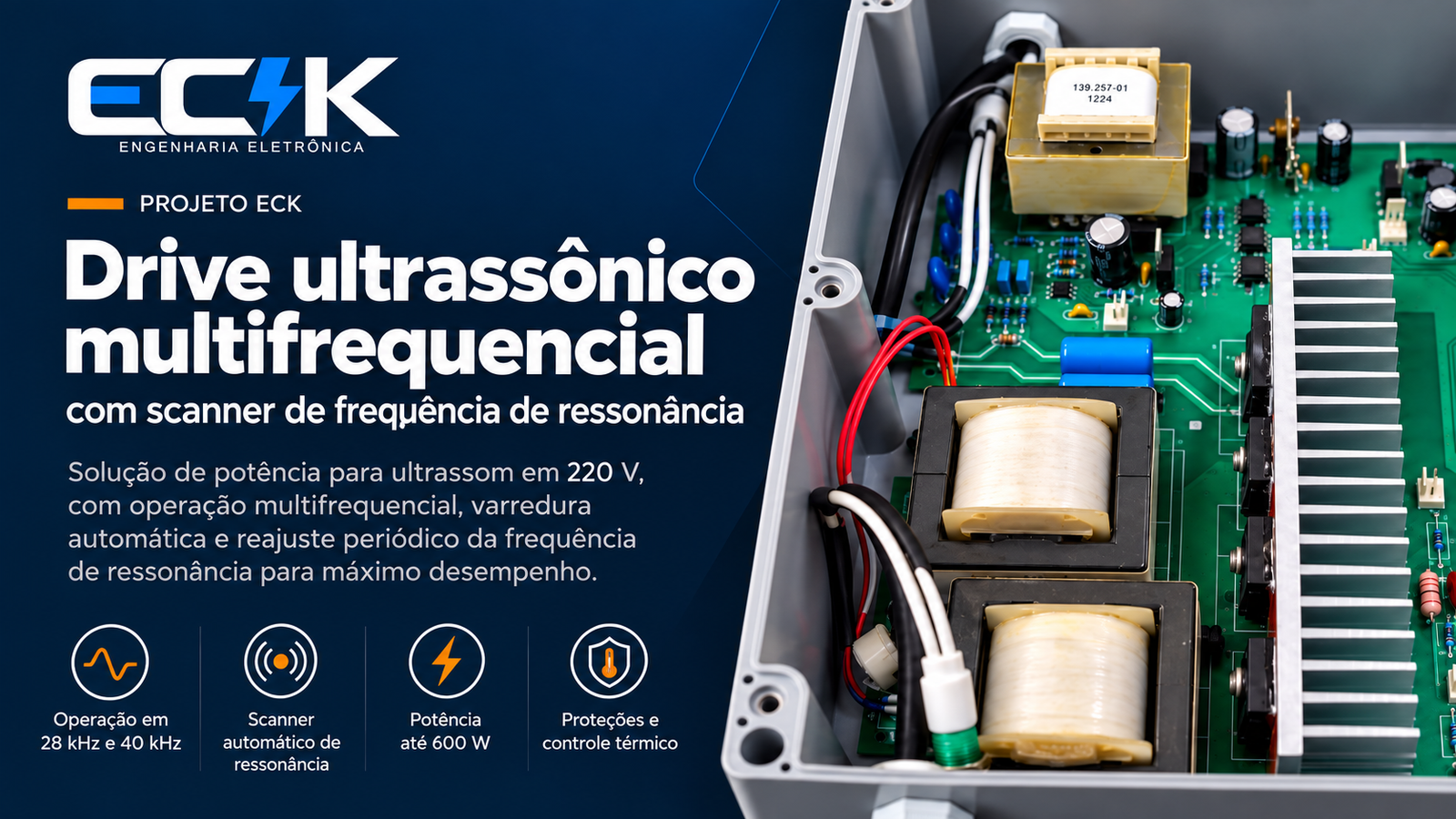
Development of this multi-frequency ultrasonic driver started from the need for a solution to complement the existing models powered by 12 V and 48 V batteries, adding a version powered directly from the 220 V mains, able to drive ultrasonic transducers at different frequencies.
Beyond fixed-frequency operation, the device had to perform an automatic frequency sweep, identify the resonance region of the assembly and periodically re-tune its operation to maintain the best possible performance.
Operation at different ultrasonic frequencies
The project was designed to allow transducers in different frequency bands to be used, including applications at roughly 28 kHz and 40 kHz.
This required the power stage, and especially the output circuit, to be sized so that the same hardware concept could serve different transducer configurations.
The first version was designed for roughly 100 W. During testing, however, we found that the IGBT stage had a wide thermal margin, showing a low temperature rise even in continuous operation.
This made it possible to evolve the design to a version of roughly 600 W, which required redesigning the transformers and the output circuit.
How the multi-frequency ultrasonic driver finds resonance
One of the main features of the multi-frequency ultrasonic driver is its ability to automatically find the transducer’s best operating region.
The driver sweeps through a frequency range while electrically monitoring the power stage. From these measurements, the system identifies the condition associated with the assembly’s resonance and selects the corresponding operating frequency.
After a certain period of operation, the search can be run again.
This matters because the resonant frequency of an ultrasonic assembly is not necessarily fixed. It can shift with the transducer, installation, mechanical load, temperature and operating conditions.
With periodic searching, the device can re-tune its frequency without relying on a fixed value set only at manufacturing.
The power stage challenge
Increasing power from roughly 100 W to the 600 W range did not simply mean using higher-rated semiconductors.
An important part of the development was sizing the transformers, IGBT drive and output circuit.
Electronic switching naturally produces a waveform rich in harmonics. However, it is not desirable to pass all of that content indiscriminately to the transducer assembly.
So the output stage design has to account for the interaction between switching, transformer, inductance, capacitance and the impedance the transducer itself presents in the resonance region.
The output filter therefore played a key role in the device’s performance, reducing unwanted waveform components before they reached the transducer.
Thermal control and protections
Since this is power equipment intended for extended operation, the design also included protection and monitoring features.
These include temperature measurement, supervision of electrical conditions and mechanisms to prevent an abnormal condition from being sustained on the power stage.
Measurements taken during testing were also useful to check the thermal behavior of the assembly. Even at significant power, the semiconductor stage showed an adequate thermal margin, thanks to the sizing of the circuit and heatsink.
Results in the field
The device later went into volume production and showed a low field return rate.
After the initial development phase and the adjustments to the power stage, transformers and output filter, no significant redesign was needed to fix recurring operating problems.
This outcome was particularly important in this project: besides reaching the target power and operating modes, the device proved robust enough for continuous use.
Power electronics development for ultrasound
Multi-frequency ultrasonic driver projects combine several areas of electronic engineering: power electronics, control, magnetics, signal acquisition, thermal design and load characterization.
ECK develops hardware and firmware for industrial electronic equipment, from defining the architecture and power stages through to prototypes, testing and preparation for production. See other electronic engineering projects developed by ECK.
Have electronic equipment or a power stage to develop?
Tell us the problem. The conversation starts with engineering, not with an off-the-shelf package.