
Electronic container lock with GPRS, GNSS and LoRa tracking
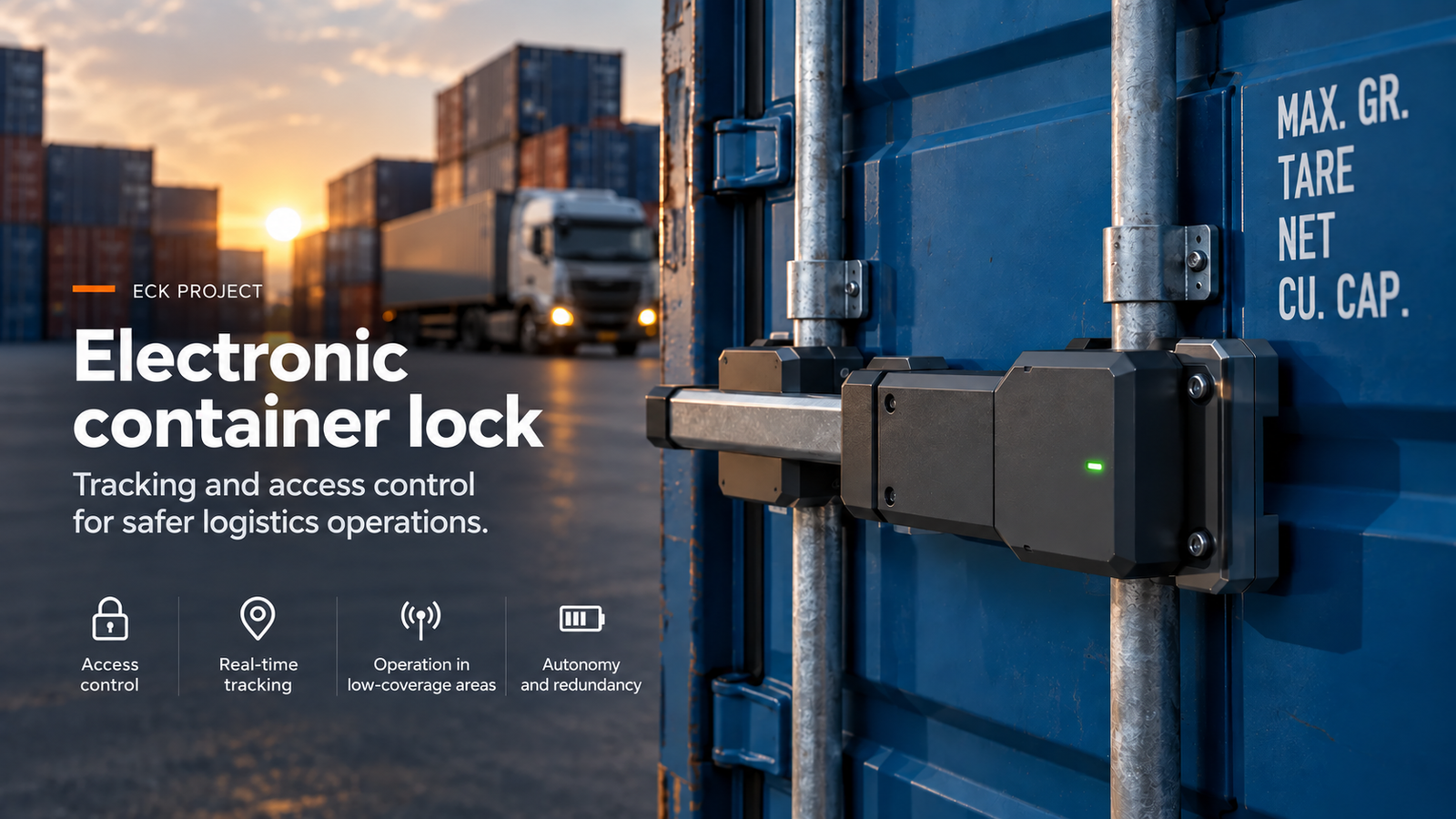
Electronic container lock with tracking
This container lock started from an existing device that needed to be redeveloped. ECK was tasked with rebuilding the electronics while solving limitations that showed up when the lock was used in real operation.
The device combines tracking, communication and opening control in a single unit mounted directly on the container. That brought an unusual mix of challenges: battery life, occasional lack of cellular coverage, GNSS positioning, very little internal space and several RF sources running very close to one another.
A container lock cannot rely on the network alone
One of the most important questions was what would happen when normal operating conditions were no longer there.
The truck might be in an area without GSM coverage. The internal battery might run flat. Even then, there had to be a controlled way to open the container, without simply releasing the lock anywhere.
So the design had to handle different authorization conditions. Opening could depend on the position obtained from GPS or on a password entered locally. We also provided a way to temporarily power the device from an ordinary external battery in case the internal battery was discharged.
This redundancy was especially important because a complete electronics failure would mean having to remove the lock mechanically.
RF inside an aluminum box
Another problem appeared during physical integration.
Available space was tight, and the mechanical design used an aluminum enclosure with boards mounted very close together. The cellular modem, GPS, processor and other circuits all had to coexist within that volume.
During development, the GSM modem transmissions caused enough interference to falsely trigger the processor protections. We had to work on board placement, power supply, antennas and electromagnetic compatibility until the problem was eliminated.
The mechanics also required several PCB revisions before the electronics could fit properly inside the existing enclosure.
Updating the electronics
The previous design used components that were becoming outdated. In the redesign, part of the architecture was updated, including the use of a Quectel modem.
During production, issues also came up with component batches sourced from the Asian market, which required investigation and design adjustments.
A project that stopped causing trouble
After the fixes made during development and the move into production, the design no longer needed changes. For roughly three to four years, the electronics have remained in production without design revisions and without significant technical complaints reported to ECK.
The development of this container lock shows how seemingly independent requirements (battery life, cellular coverage, positioning, contingency opening, mechanics and electromagnetic compatibility) have to be treated as parts of the same system. The solution only becomes robust when electronics, firmware, power, RF and enclosure are evaluated together.
It also highlights the importance of designing for real-world operation. In the field, the device must remain usable even with a flat battery, no cellular network or mechanical constraints that do not show up in a purely schematic analysis.
Another key point was making different communication technologies work together inside a small metal enclosure. That required reviewing the power supply, board placement, antennas and system behavior during RF transmissions. The result was a solution that combined tracking, access control and autonomy without depending on a single form of communication.
See other electronic engineering projects developed by ECK.
Have an electronic project to develop?
Tell us the problem. The conversation starts with engineering, not with an off-the-shelf package.