
Water resource manager with Ethernet
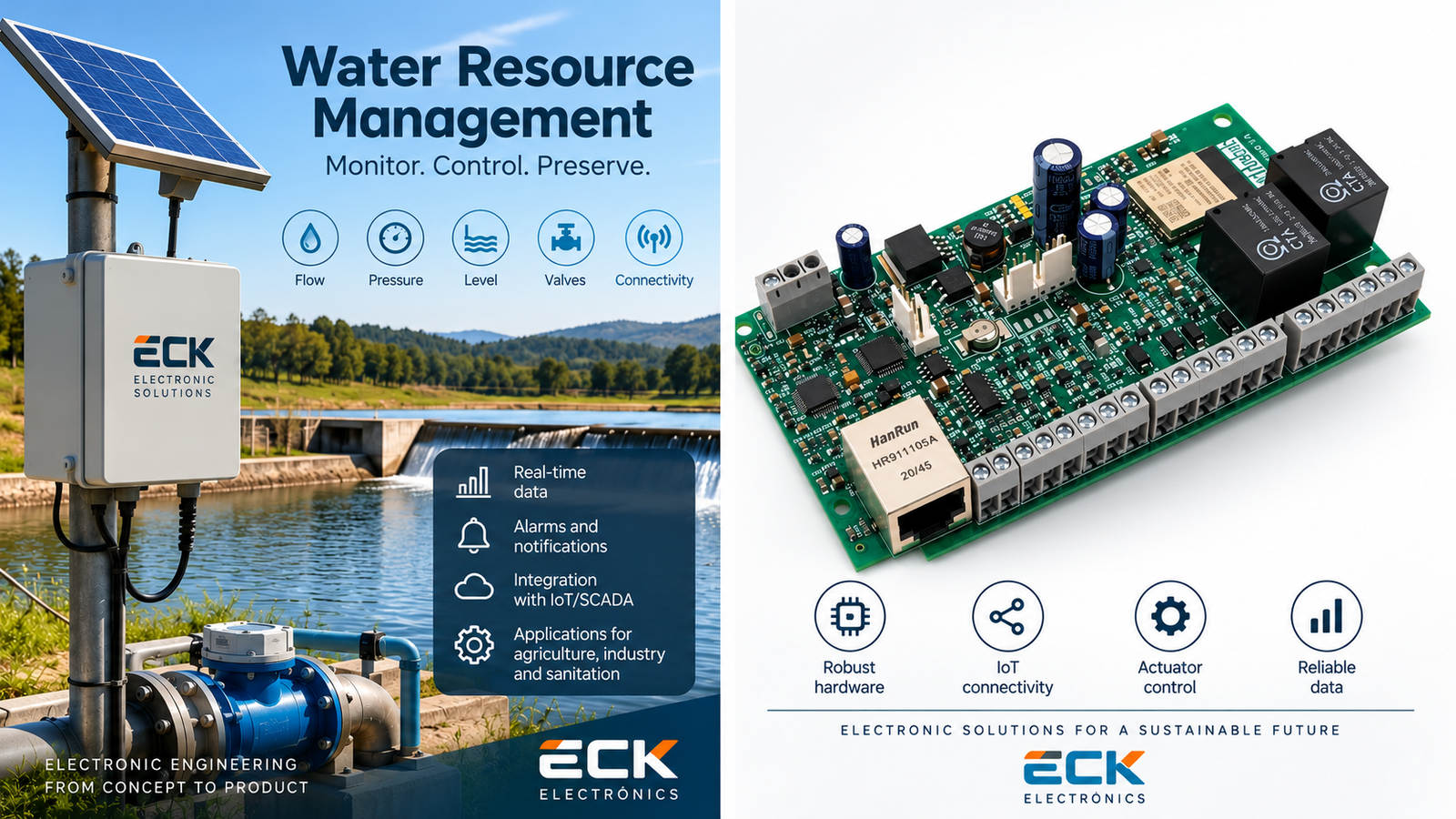
Water resources require reliable monitoring even where communication infrastructure is limited. This project grew out of the need to keep an existing product in step with a change happening outside it: communication networks were changing, and a solution that depended on 2G and 3G had to remain useful for many years to come.
ECK had already developed an earlier version of the system. As the equipment evolved, the goal was no longer simply to swap a modem. It was necessary to create new communication alternatives, serve remote installations and make field configuration and integration easier.
Monitoring water resources when the network changes
With 2G and 3G networks expected to be shut down, keeping the whole architecture dependent on cellular communication would have limited the product. The new version adopted Ethernet as one of its main connections and kept the option of using an external modem when needed.
The ESP32 added Wi-Fi and Bluetooth to the device. This also made it possible to carry out configuration tasks locally through a built-in web server, including from a mobile phone during setup.
And when there is no network at all?
Some water monitoring sites are located precisely where communication infrastructure is most limited. For these locations, the design included an interface for Globalstar satellite communication.
As a result, the same device can serve anything from a site with Ethernet available to remote points with no cellular coverage. A typical application is reading the level of wells and rivers with 4–20 mA sensors and sending that data to the customer system.
One board that talks to different systems
The electronics include four digital inputs, used for functions such as flow, pulse counting and hour metering, four 4–20 mA analog inputs and two relays. The device also keeps a log of up to 2,000 events.
Over Modbus, the system also communicates with a Kron three-phase meter/controller, reading electrical quantities such as voltage, current, active and reactive power and power factor. This information allows management to go beyond water monitoring and also take into account the site energy consumption and demand.
Pump control can then combine data from the level meter with energy consumption and cost parameters, blocking the pump when necessary. In this way, the system can manage not only when water needs to be pumped, but also when pumping is most convenient from an energy standpoint.
The integration challenge was not limited to the physical interfaces. The board had to handle different protocols and services, including DHCP, static IP, NTP, MQTT, Modbus, HTTP and communication with the satellite modem.
MQTT made integration with supervisory systems simpler, while the web server reduced dependence on specific tools for field configuration.
An evolution, not just a replacement
The result was a more flexible platform than the previous version. Instead of simply replacing aging cellular communication, the redesign opened up Ethernet, Wi-Fi, Bluetooth and satellite options and broadened the range of applications for the device. Integrating level measurement, electrical quantities and pump control also turned the monitoring system into a water and energy management tool.
This kind of architecture shows how water resource monitoring can require integration between sensors, communication, electrical measurements and control logic. See other electronic engineering projects developed by ECK.
Have an electronic product to develop?
Tell us the problem. The conversation starts with engineering, not with an off-the-shelf package.