
GPRS/GPS vehicle tracker with tachograph interface
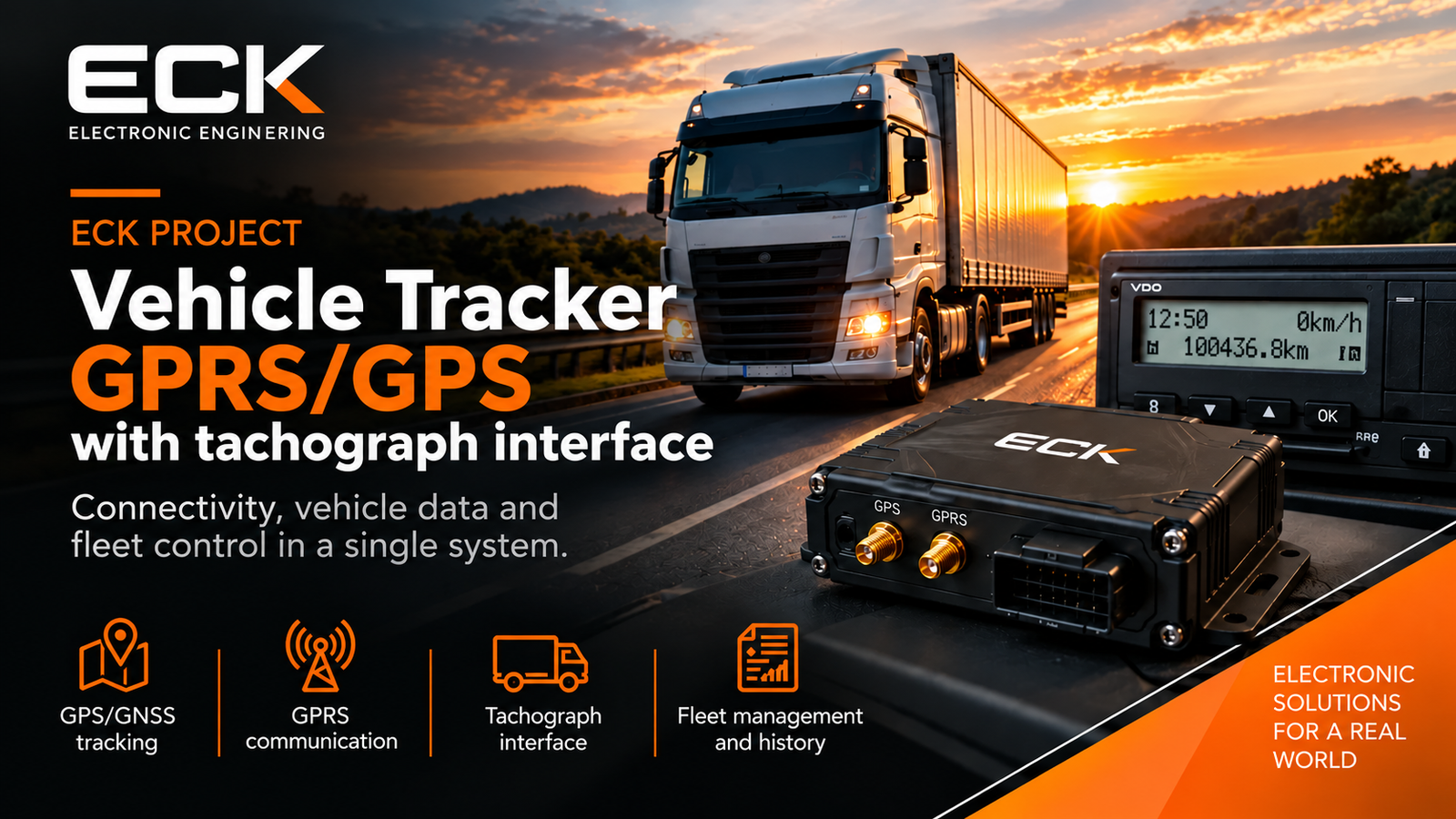
Developing a vehicle tracker with tachograph integration
Development of this vehicle tracker began in the early 2000s, when ECK was approached to create a tracking system intended mainly for trucks and commercial vehicles.
The client already had strong experience developing tachographs, but did not yet master the technology needed to build a complete tracker. ECK involvement therefore covered not only product development, but also support and training for the client engineering team.
The project evolved over several generations of hardware and firmware.
First generation: MSP430, GPS and GPRS
The first version used an MSP430 microcontroller, chosen mainly for its low power consumption, together with a cellular modem and a GPS receiver.
The embedded firmware was written in ANSI C, which kept the architecture relatively independent of the microcontroller.
Communication with the servers used UDP, with compression mechanisms designed to reduce the amount of data sent over the cellular network.
The system implemented features such as history storage and retrieval, GPS positioning and geofencing.
Scaling the communication
One challenge appeared when the system started operating with a much larger number of trackers.
The pilot batch reached roughly one thousand devices, creating a communication load that the originally available infrastructure could not handle properly when many devices tried to transmit at the same time.
A strategy to distribute these connections had to be built into the embedded system itself.
The trackers dynamically obtained the available addresses and used four servers/IPs, spreading the devices among them. The device ID determined which server each tracker should send its data to.
This architecture reduced the concentration of connections on a single point and allowed the infrastructure to grow to support a larger fleet.
Second generation: migrating from MSP430 to Freescale
In the next evolution of the product, the hardware was migrated from the MSP430 to a Freescale microcontroller.
The new processor delivered similar power consumption at a more competitive cost at the time.
Because the firmware had been structured in ANSI C, the migration preserved much of the previously developed architecture and code.
This stage showed a key advantage of properly separating application logic from hardware specifics.
Third generation: tachograph integration
The following evolution integrated tachograph data into the tracker.
The goal became combining positioning, cellular communication and vehicle operating data in a single system.
However, a hardware limitation came up: the microcontroller had only two serial interfaces available. One was already assigned to the GPRS modem and the other to the GPS receiver.
Communication with the tachograph required a third interface.
The solution was to implement a software UART, adding the required communication without replacing the processor or completely changing the existing electronic architecture.
Engineering and technology transfer
ECK work did not end with the development of the device.
The client had its own engineering team and wanted to take over future evolutions of the product. That is why an important part of the project was dedicated to knowledge transfer.
We ran training sessions and technical discussions on firmware development, code organization, documentation, commenting, version history and development methodology.
As a result, the project left behind not only a product, but also a team ready to keep evolving it.
Result
The tracker went through several generations: it started as a low-power GPS/GPRS system, received a new processing platform, evolved its communication infrastructure to handle a larger number of devices and finally incorporated the tachograph interface.
The project is an example of how ECK can work at different levels of a development: hardware, embedded firmware, communication protocols, integration between devices, architecture analysis and training of the client engineering team. See other electronic engineering projects developed by ECK.
Have an electronic product to develop?
Tell us the problem. The conversation starts with engineering, not with an off-the-shelf package.