
IoT control system for poultry farming
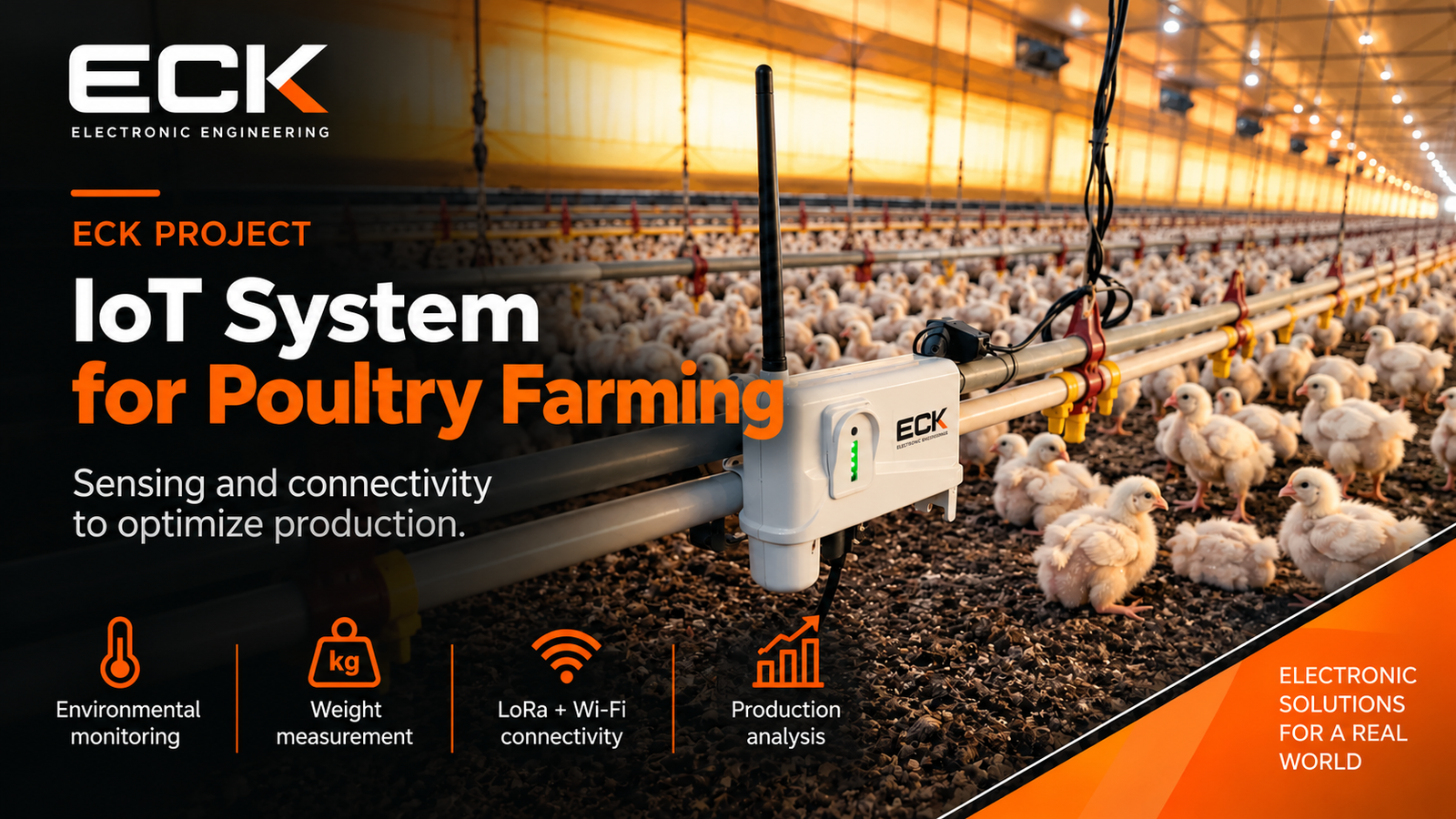
An IoT system for poultry farming with sensing, weighing and connectivity that turns field data into production insights.
The project grew out of Trinovati need to develop an IoT system for poultry farming to monitor broiler production in a cooperative. The platform had to collect data directly in the poultry houses and deliver it to a central analysis system.
The goal went beyond simply measuring temperature and humidity. It was to integrate different production parameters (environmental sensors, weighing, water consumption, ventilation and electrical quantities) into an acquisition and communication infrastructure able to operate under real farm conditions.
With thousands of producers belonging to the cooperative, the data could help answer an important question: why did some farms achieve better results than others? The project shows how hardware, firmware, sensors and communication can form a single IoT architecture applied to production. See other electronic engineering projects developed by ECK.
IoT system for poultry farming: the challenge
Trinovati had strong software and data analysis skills, but needed support developing the hardware and firmware for the devices installed in the field.
ECK took part in the project by developing the electronics for sensor acquisition and data communication.
The quantities planned for the system included temperature, humidity, weight, air speed, water consumption, air quality, equivalent CO₂, volatile organic compounds, electric current, pressure and light level.
This turned the device into a true sensor hub for the poultry house.
Hardware built for the production environment
The system had to operate directly at the producers sites and use commercially available components, so the devices could later be manufactured.
Several sensors and circuits were used, including the TSL25721, CCS811, DS18B20, SPD810, CS2482S and SHT3, as well as 10 kΩ NTC sensors.
For weighing, we used the CS5530, a high-resolution A/D converter ECK already knew well from weighing applications.
Measuring air speed also required a dedicated mechanical solution, with parts produced by 3D printing.
LoRa and Wi-Fi to connect the poultry houses
One of the main challenges was moving the collected data around the facilities.
To do this, the project combined two communication technologies.
Long-range communication used LoRa with RFM95 modules, while ESP32-based devices also provided Wi-Fi connectivity.
This way, the different acquisition points could send their data to a central unit that consolidated production data.
The system was also designed to run either on mains power or on battery, selecting the power source automatically and keeping the battery charged.
Data to understand production
The purpose of the project was not just to put sensors inside a poultry house.
Data collected at the producers was sent to a platform developed in Python, which consolidated and analyzed the information.
This made it possible to compare environmental and production parameters across different farms.
The idea was to identify which conditions were associated with the best results and use that information to improve production for the other members.
Producing better, not simply producing faster
In industrial poultry farming, uniformity and production time have a direct impact on economic results.
A flock whose birds reach similar weights within the planned period also makes later stages of the production process easier, such as automated processing.
But this efficiency has to be achieved without compromising animal health.
That is why information on weight, temperature, ventilation, air quality, water, lighting and energy consumption becomes valuable when analyzed together.
Instead of looking only at the final result, the system made it possible to track the conditions that contributed to it.
From individual measurement to collective intelligence
The scale of the cooperative created another interesting possibility.
With centralized data from a large number of producers, it would be possible to identify practices that delivered better results and use them as a reference for other members.
The same data infrastructure could support the planning of collective actions, such as feed purchasing, vaccination and monitoring of production conditions.
So the device developed for the field was just the first layer of a larger architecture:
sensors → electronic acquisition → LoRa/Wi-Fi → centralization → data analysis.
Applied engineering
In this project, ECK focused mainly on developing the hardware, firmware, sensor acquisition, weighing and connectivity.
The initial deadline for the prototype was roughly 45 days, driven by the startup commitments to its investors.
The result was an electronic platform able to bring together different sensors and carry information from the real production environment to a central analysis system.
Have an electronic product to develop?
Tell us the problem. The conversation starts with engineering, not with an off-the-shelf package.